


The Japanese word for a formal meal in courses is kaiseki, written with characters meaning stone in the bosom/heart. Zen monks fasting through the evening are said to have held a warmed stone against the stomach to dull the hunger. The meal that inherited the name was never meant to be large. It was meant to be exact.
That idea still governs a Japanese tasting menu. At Satori in Moseley there are two of them: a Classic Tasting Menu at £95 for eight courses, and a Signature Tasting Menu at £145 for six and also includes our signature cocktail. Both are served in a fixed order across an extensive 2-3 hrs experience, both are priced per person, and both require a minimum of two guests.
This guide explains how a Japanese tasting menu is built, how the two Satori menus differ from each other and from omakase, and what actually arrives at the table.
What makes a Japanese tasting menu different
A European tasting menu tends to showcase a chef. A Japanese one is organised around the ingredient and the calendar.
The governing idea is shun, the short window in which something is at its best. The character originally marked a ten-day period, which gives a sense of how narrowly the word is meant. Shun is not the season. It is the fortnight inside the season when the mackerel has the fat, or the scallop has the sweetness, and a kitchen working this way will change a course because the ingredient moved, not because the menu was due a refresh.
The second idea is that no technique should repeat. In classical kaiseki every course is cooked a different way, which is the rule that keeps a long meal from becoming monotonous. Satori is not a kaiseki restaurant and does not present itself as one. What it takes from the tradition is that rule, applied to a contemporary Japanese menu.
You can see the rule working across a single evening. Raw gives way to simmered, then fried, then grilled, with the temperature and the richness climbing a step at a time. Eight courses do not feel like eight courses when no two of them are made the same way.
Tasting menu or omakase?
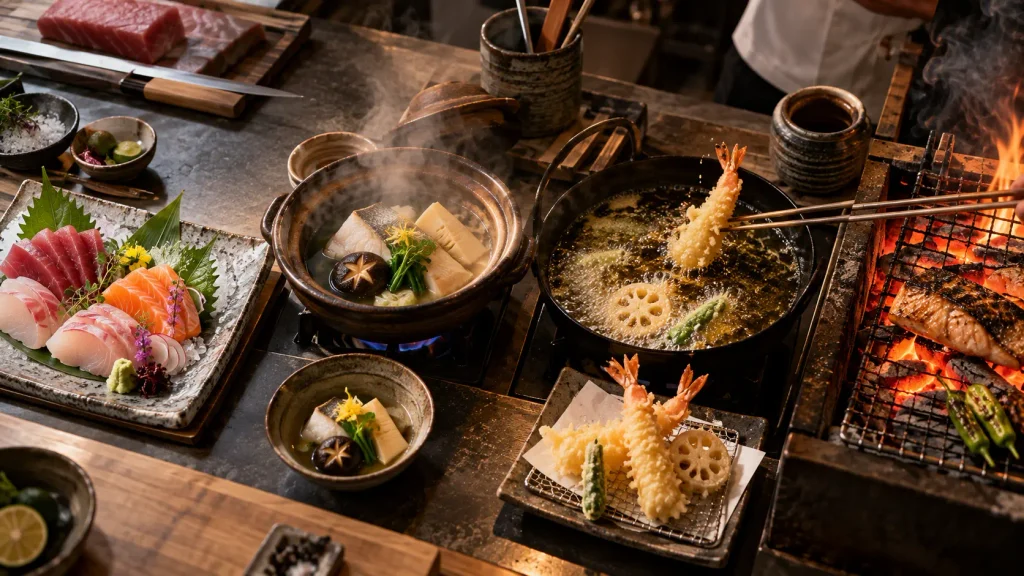
The two are often used interchangeably on Birmingham menus, and they are not the same thing. A tasting menu is written. The courses are decided in advance, printed, and served to every guest that evening in the same order. You know what is coming.
Omakase comes from makaseru, to entrust, and the phrase translates roughly as I leave it to you. Nothing is written down. The chef reads the counter, the delivery and the guest, and builds the meal as it goes.
Satori runs both. The Signature Omakase is £55 per person and its courses are not published, which is the point of it. The tasting menus are longer, broader and written down in advance.
For a first visit the tasting menu is the easier choice, simply because you can see what is coming. The omakase is the shorter, chef-led route, and it suits a return visit once you know what the kitchen does well.
The shape of the evening
A Japanese tasting menu moves in one direction: clean to rich, cool to hot, raw to grilled.
Both menus open with raw fish, while the palate is still clean, because sushi and sashimi are the dishes most easily spoiled by anything eaten before them. Heat enters afterwards, and the two menus then diverge.
At Satori the two menus answer that differently. The Classic covers more ground. The Signature spends its money in fewer places.
| Classic, £95 | Signature, £145 | |
| Opens with | Sushi platter: salmon and tuna nigiri, salmon and avocado maki, salmon & tuna sashimi | Hinomaru, our Signature cocktail xsashimi and sushi platter with hamachi, Wagyu and truffle futomaki, crab California maki |
| Soup or noodles | Miso soup with langoustine, tofu and spring onion | Hotate and shiitake udon noodles with scallops and miso |
| Middle | IKA tempura;Karaage Fried Chicken; tea-smoked miso aubergine; salmon and tuna tataki with ponzu | Ebi & Yasai Tempura; miso black cod with pak choi and sake butter |
| Main | Grilled pink pepper lamb cutlet, yuzu mint yoghurt, Wagyu-dripped chips with nori | Wagyu steak and lobster, yakiniku sauce |
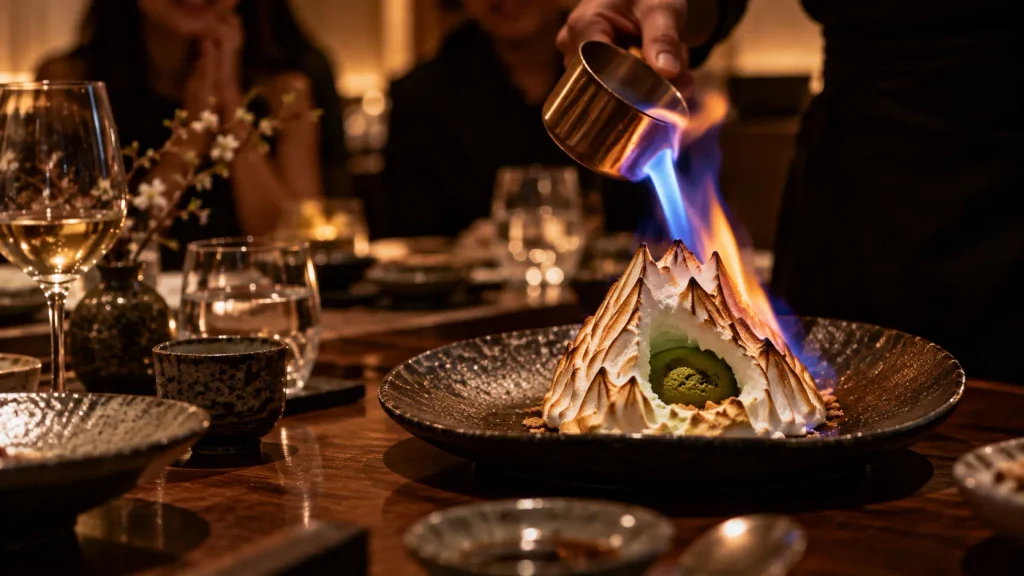
| Dessert | Japanese coffee crème brûlée with chocolate brownie | Baked Mount Fuji: matcha ice cream and meringue, set alight at the table |
| Courses | Eight | Six |
The Classic is the broader education and traditional cooked. It touches sushi, soup, tempura, a Japanese-inspired Karaage, a vegetable course and seared fish before it reaches the grill, so you leave having seen most of what the kitchen can do.
The Signature is the richer and our Signature dishes involved in theatrical evening. It opens on a cocktail rather than on food, puts Wagyu and truffle into the first course, and ends with a dessert the MICHELIN Guide singles out, lit at the table.
The tea-smoked miso aubergine on the Classic is worth noting separately. It is the vegetarian course, marinated in miso and smoked with tea and finished with sesame rather than assembled as a trilogy.
If you are deciding between this and an à la carte evening, the honest difference is control. A tasting menu takes the decisions away from you and hands the pacing to the kitchen. That is the appeal, and for some guests it is the drawback.
What to know before you book
Set aside the whole evening. A tasting menu is paced by the kitchen, and courses are fired in sequence rather than on request. Two to three hours is the normal range. It is a poor choice if you have a train to catch or theatre tickets at eight.
Book ahead, and tell them everything then. Tasting menus are prepared against the number of covers, so dietary requirements, allergies and anything you dislike need to be raised when you reserve rather than when you sit down. Most kitchens can work around most things with notice and very few can do it on the night.
Expect to be led. You will not choose your courses. If someone at the table is a cautious eater, the à la carte menu is the kinder option, and there is no loss of face in saying so.
Both menus need a minimum of two guests. Tasting and omakase prices are per person, and the kitchen prepares against confirmed covers. For larger parties, or anything needing a private room, private hire is the route rather than a standard booking.
Budget for the pairing. Wine, cocktail and sake pairings are £55 each, and a discretionary 12.5% service charge applies. The Classic with a pairing comes to £150 a head before service, the Signature to £200.
Current course counts, pricing, sittings and dietary provision are listed on the Satori menus page and in the FAQ. Check both before booking. Courses and prices change through the year, and the live menu page is the only reliable source.
Japanese fine dining in Birmingham
Birmingham has more serious restaurants than its reputation suggests, and the MICHELIN Guide’s Birmingham selection is the clearest picture of where the city currently stands. Japanese fine dining remains the thinner part of that picture, which is the gap Satori occupies.
Satori is in Moseley rather than the city centre, about three miles south, and is featured in the MICHELIN Guide. The location matters more than it sounds. Moseley is residential, which tends to produce a quieter room and a longer evening than the high-turnover sites around Broad Street and Brindleyplace.
The Guide’s own note on the restaurant puts the case for the format plainly: if you want a taste of it all, the well-priced tasting menu is the best option. That is a fair summary of the choice. Ordering à la carte shows you dishes. The tasting menu shows you the restaurant.
For a tasting menu experience in Birmingham, that difference is practical rather than romantic. A menu paced across three hours needs a dining room willing to give the table up for the night.
Common questions
How much is a tasting menu in Birmingham at Satori? The Classic Tasting Menu is £95 per person and the Signature Tasting Menu is £145. Wine, cocktail and sake pairings are £55 each, and a discretionary 12.5% service charge applies.
How long does a tasting menu take? Two to three hours is standard. The kitchen sets the pace, so courses cannot be rushed or reordered.
What is the difference between a tasting menu and omakase? A tasting menu is written in advance and served in a set order. Omakase is unwritten and composed by the chef as the meal goes on. At Satori the tasting menus are £95 and £145; the Signature Omakase is £55.
Can dietary requirements be accommodated? Give notice when you book, since courses are prepared in advance. The Classic includes a vegetarian futomaki in its opening platter and a tea-smoked miso aubergine course.
Is a tasting menu suitable for a first visit to a Japanese restaurant? Yes. It is the clearest way to understand what a kitchen does, and it removes the difficulty of ordering from an unfamiliar menu.
Is there a minimum number of guests? Yes. Both tasting menus and the omakase require a minimum of two people, priced per person.
Is it a good choice for an anniversary or birthday? It suits a long, seated occasion. For a celebration with a larger group, ask about private hire instead.
A meal built this way is worth giving an evening to. See the current tasting menu at Satori.